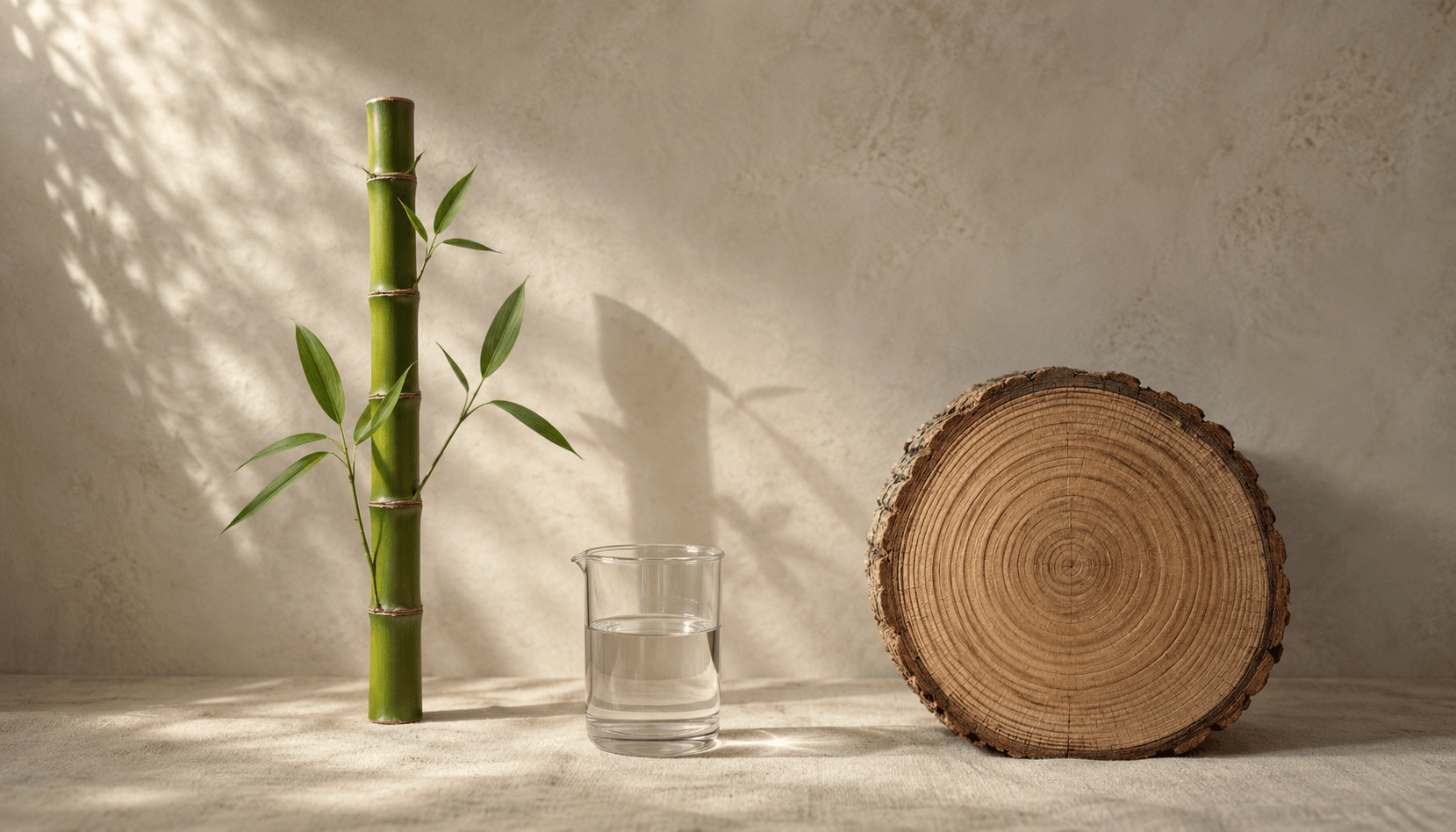
Bamboo vs Wood: A Side-by-Side Look at Growth, Water and Carbon
How bamboo really compares to softwood pulp on the four metrics that matter — growth cycle, water use, carbon sequestration, and fibre quality. Plus an honest section on where bamboo's footprint isn't zero.
"Bamboo is better than trees" is the kind of marketing line that's been printed on enough eco packaging to start sounding suspicious. It is, broadly, true. But the interesting story is in the how much and the where it isn't.
This post walks through a side-by-side comparison of bamboo and softwood — the two main fibre sources for tissue paper — across the four metrics that actually matter: growth cycle, water use, carbon, and fibre quality. It ends with the honest part: where bamboo's footprint is not zero, and where the comparison gets murkier.
Growth cycle: the most lopsided comparison
The single biggest difference between bamboo and softwood is the harvest cycle, and it isn't close.
- Softwood (pine, spruce, fir, eucalyptus): A managed plantation takes 20 to 25 years to grow to harvest size. Boreal softwoods used in northern tissue mills take 80 to 200 years to mature in the wild. Replanting is required after every harvest.
- Bamboo (Bambusa, Dendrocalamus, Phyllostachys): A clumping bamboo grove yields harvestable culms in 3 to 5 years from initial planting. After the first harvest, new culms regrow from the same rhizome system every year — there is no replanting cycle.
Some species of Moso bamboo grow at rates that have been measured at up to 91 cm per day under ideal conditions during the spring growth burst. That's not a marketing exaggeration; it's the actual measured rate, and it's part of why bamboo's biomass-per-hectare-per-year is so much higher than any softwood.
The practical consequence: bamboo can be harvested annually from a mature grove without depleting it. Softwood plantations cannot.
Water use: meaningful but not magical
Bamboo's water-use advantage is real but smaller than the growth-cycle gap.
- Softwood pulp consumes roughly 15,000 to 25,000 litres of water per ton of finished tissue through cultivation, pulping, bleaching, and drying.
- Bamboo pulp consumes roughly 10,000 to 18,000 litres per ton for comparable processes.
That works out to a 20 to 35 percent reduction in water footprint, depending on mill, species, and bleaching method.
The cleanest part of the comparison is on the cultivation side. Bamboo in South and Southeast Asia is almost entirely rain-fed, growing in monsoon-watered groves without irrigation infrastructure. Eucalyptus and pine plantations in many regions require some level of irrigation, especially in dry years.
The pulping and bleaching stages, on the other hand, use roughly similar amounts of water for both fibres — most of the savings is upstream of the mill.
Carbon: faster sequestration during growth, similar at end of life
Carbon is the metric where the math is trickiest, and where bamboo marketing tends to overclaim.
What's genuinely true:
- A mature bamboo grove sequesters carbon at a rate of roughly 8 to 25 tonnes of CO2 per hectare per year during its rapid growth phase, depending on species and climate. This is comparable to or slightly higher than a fast-growing softwood plantation in similar conditions.
- Because bamboo regrows from the rhizome, the carbon stored in the root system remains in the ground after harvest. Softwood plantations lose most of their stored carbon when replanted, because the new saplings are tiny.
What's misleading if oversimplified:
- The carbon stored in the harvested fibre itself is released back to the atmosphere when the tissue paper biodegrades after use, regardless of whether it's bamboo or wood. From a long-run carbon balance, only the standing biomass and root carbon matter.
- Bamboo manufacturing energy is similar to or slightly higher than softwood, because bamboo culms have a tougher silica-rich outer layer that requires slightly more energy to pulp.
The net carbon advantage of bamboo over softwood, on a full lifecycle basis, is real but modest — probably in the order of 10 to 25 percent lower CO2 equivalent per ton of finished tissue, not the "carbon negative" claims you sometimes see on packaging.
Fibre length and strength: the consumer-facing trade-off
Fibre quality is the metric most consumers actually notice when they switch.
- Long-fibre softwood (northern pine, spruce): Average fibre length 3 to 5 mm. Long fibres make tissue feel strong and durable.
- Short-fibre hardwood (eucalyptus, birch): Average fibre length 0.8 to 1.5 mm. Short fibres make tissue feel soft and absorbent.
- Bamboo: Average fibre length 1.5 to 3 mm — sits between long-fibre softwood and short-fibre hardwood. This is genuinely useful: bamboo tissue feels both soft and strong without needing to be blended.
- Recycled fibre: Average length 0.5 to 1 mm and degrading with every recycling cycle. This is why 100 percent recycled tissue feels noticeably less soft.
In practical terms, well-made bamboo tissue feels softer than recycled tissue and roughly comparable to mid-tier virgin softwood tissue. The texture difference between premium virgin softwood and premium bamboo, in our own testing, is small enough that most blind testers don't reliably tell them apart.
The honest section: where bamboo's footprint isn't zero
If we're being fair, here are the parts of bamboo's footprint that often get glossed over.
- Freight. India produces a lot of bamboo, but the largest bamboo pulp mills are currently in China. Some Indian bamboo tissue brands import pulp or finished product from Chinese mills, which adds shipping emissions. The honest answer is that bamboo tissue with a long freight leg is still better than virgin softwood tissue, but it's not as good as bamboo tissue from a domestic Indian mill. We discuss our own sourcing on the our bamboo story page.
- Pulping chemistry. The kraft and soda pulping processes used for bamboo are similar to those used for softwood and use the same chemical inputs. Bamboo is not inherently a "clean" pulp; the cleanliness depends on the mill's effluent treatment.
- Monoculture risk. Large-scale bamboo plantations can become monocultures with reduced biodiversity, the same way eucalyptus plantations do. The best bamboo sources are smaller mixed groves or community-managed forests rather than industrial monocultures.
- Scaling limits. Global bamboo supply is large but not infinite. If every paper product in the world tried to switch to bamboo tomorrow, prices would spike and land-use pressure would shift. Bamboo is a great answer for tissue and packaging; it isn't a universal solvent for the paper industry.
The summary
Across the four metrics that matter, bamboo's advantage over softwood looks like this:
- Growth cycle: bamboo wins by 4 to 50 times, depending on the comparison softwood.
- Water use: bamboo wins by roughly 20 to 35 percent per ton.
- Carbon: bamboo wins by roughly 10 to 25 percent per ton on a full lifecycle basis.
- Fibre quality: bamboo is roughly comparable to mid-tier virgin softwood, noticeably better than recycled.
This is a real, meaningful, defensible improvement — not a marketing fiction. It is also not infinite. The right framing for bamboo tissue is "the best practical fibre source for a single-use disposable category that probably shouldn't exist at all but does, so let's make it from the least-bad option."
If that pragmatic framing matches how you think about household sustainability, the products page is where the rolls live and the subscription page is how most people end up actually keeping the swap going.
Ready to buy?
Browse our full product catalogue or request wholesale pricing.