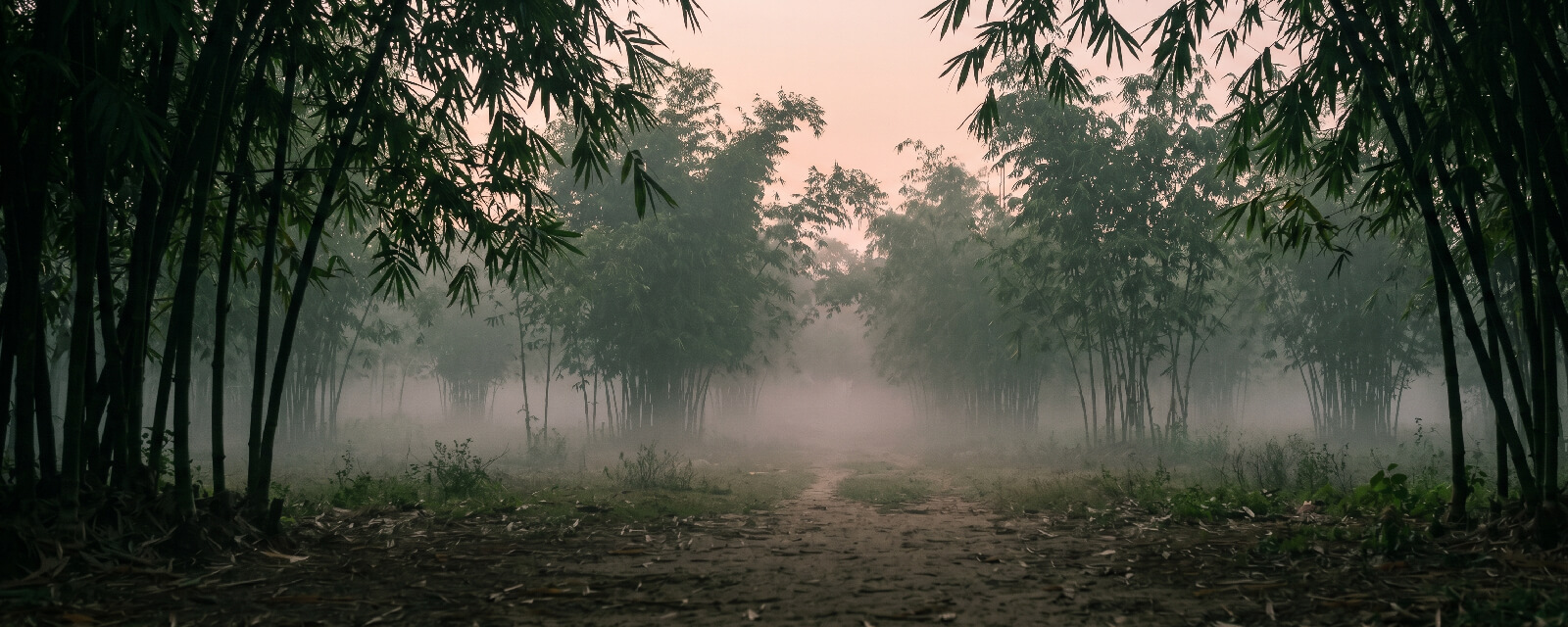
Our Bamboo Story
We swap tree pulp for bamboo. That's it. That's the story.
Everything you flush, every kitchen mess you wipe, every facial tissue you reach for — could be made from a grass that regrows itself in 3–5 years, instead of a hardwood that takes 20+. We make that swap easier.
1. Why bamboo, not trees
Bamboo is the world's fastest-growing plant — some species shoot up 90 cm in a single day[1]. Once a culm is harvested, the underground rhizome simply sends up another shoot. No replanting. No tilling. No herbicide. The same patch yields year after year for decades.
Compare that to a virgin-pulp paper mill: hardwood forests take 20+ years to mature[2], and every ton of finished tissue paper requires roughly 17 trees[3] and 90,000 litres of water[4]. The same ton of bamboo tissue? Zero trees felled. Roughly 30% less water in manufacture[5]. The fibre is longer than recycled fibre, so the finished sheet is genuinely softer — not the rough-recycled compromise we've been trained to accept.
2. How we make it
- Source: FSC-certified bamboo plantations across India and selected Asian partners. Chain-of-custody traceable to the plantation block.
- Pulp: Mechanical separation + closed-loop water recovery. No chlorine. We use TCF (totally chlorine-free) bleaching — oxygen-based — so there are no organochlorine residues in the finished paper or in the mill's water discharge.
- Manufacture: Modern paper-machine technology with energy recovery and a full water-recycling loop. Off-cuts and trim go back into the pulp stock — zero fibre waste.
- Pack: Paper wrap. Paper carton. No shrink-wrap, no plastic film, no polybag. The wrap is recyclable in any kerbside paper stream.
- Deliver: Air-courier eligible (bamboo tissue isn't a dangerous good) → 2–8 day delivery to most Indian pin codes.
3. Certifications & what they mean
BambooPaper.in is the trader — we source from FSC-certified mills in India, verify each consignment against the supplier's certificate pack, and pass the license details through to you. We don't operate the mill ourselves, but every claim below is anchored to a document from the manufacturer that we hold on file and can share on request.
-
100% Bamboo Fibre
What it covers: the pulp source — 100% bamboo, zero virgin tree-pulp, zero recycled wastepaper fibre.
How we verify: supplier's source-of-pulp declaration on every consignment lot, cross-checked against the supplier's FSC certificate (available on request).
-
FSC-Certified Bamboo Source
What it covers: the bamboo pulp is sourced from suppliers that hold FSC certification — meaning the upstream forestry operation is independently audited against the Forest Stewardship Council's responsible-management criteria.
How we verify: we keep our suppliers' FSC certificates on file and share copies on request. Read more about FSC at fsc.org, or verify a certificate at info.fsc.org.
-
Eco-Friendly Packaging
What it covers: primary wrap (paper), inner carton (recyclable kraft), outer courier carton (kraft + paper tape). Zero shrink-wrap, zero polybag, zero plastic tape across the three layers.
How we verify: this is the one we control end-to-end — packaging spec is enforced by us, not the manufacturer. Open any BambooPaper order and you'll see paper-to-paper packaging across all three layers. Report anything else to our team and we'll refund + investigate.
-
Chlorine-Free (TCF) Bleaching
What it covers: the bleaching process — oxygen-based, with no elemental or compound chlorine. No organochlorine residue (AOX/dioxins) in the finished paper or in the mill's water discharge.
How we verify: supplier mill's process certification + ISO 14001 water-discharge testing reports on file. Our natural-brown variants ship completely unbleached — no bleach, no dye, no compound chemistry at all.
-
Vegan & Cruelty-Free
What it covers: no animal-derived inputs at any stage — pulp, sizing, finishing or packaging adhesive. No animal testing — neither the finished product nor any ingredient is animal-tested.
How we verify: supplier ingredient declaration. Bamboo pulp tissue paper doesn't typically involve animal-derived inputs by industry default, but we make the explicit declaration on every BambooPaper SKU.
-
Made in India
What it covers: the finished product is manufactured in Gujarat by our supplier mill, which runs ISO-compliant, GMP-grade processes. Bamboo is sourced from FSC-certified suppliers in India and partner Asian countries (the supplier's FSC certificate details origin proportions per consignment).
BambooPaper.in's role: we are the Indian D2C trader and distributor — we handle e-commerce, customer service, GST-compliant invoicing, last-mile logistics and quality control on every batch. Our GSTIN appears on every invoice; the manufacturer's CIN appears on the carton.
Want to see a specific certificate copy? Email us at hello@bamboopaper.in with the certificate name and we'll share the supplier copy (redacted for any commercially-sensitive fields). HORECA and wholesale buyers receive the certificate pack automatically with the first delivery.
4. Impact methodology
The homepage and per-subscription "trees saved" counters use real numbers from completed customer orders. Every product carries three impact coefficients in its metadata:
- Trees saved per unit — derived from FAO data on virgin-pulp tree equivalents[3] (1 ton of finished tissue = ~17 trees), prorated to per-roll.
- Water saved per unit — from NRDC industry-LCA data on virgin-pulp water use[4] (~90,000 L/ton), prorated.
- CO₂ avoided per unit — from comparable LCA studies that contrast bamboo versus hardwood pulp manufacture[6].
The homepage total is a sum across all completed orders, recomputed nightly. Per-subscription totals use the same coefficients summed across that subscription's cycle history. We will update the coefficients whenever our independent LCA is renewed (next: 2027).
5. Common questions
Is bamboo really better than recycled paper?
For tissue paper, yes — both for performance and sustainability. Recycled tissue uses shorter, weaker fibres that produce a rougher product; bamboo fibres are long and strong, giving a softer hand-feel at the same ply count. On the environmental side, bamboo regenerates from the rhizome (no replanting), grows 30–50× faster than hardwood, and the manufacturing process uses ~30% less water per ton than virgin tree pulp.
Is it really septic-safe?
Yes — our toilet rolls and facial tissues are independently tested to break down faster than virgin-pulp paper in septic-tank conditions. The bamboo fibre disintegrates within minutes of immersion. Kitchen towels, napkins and multi-fold hand towels are NOT designed to be flushed — they're heavier-weight and meant for the bin or compost.
What does FSC certified mean?
FSC (Forest Stewardship Council) is the independent global standard for responsibly-managed forestry. The bamboo pulp we use is sourced from FSC-certified suppliers — meaning the upstream forestry operation is independently audited against FSC's environmental and social criteria. The supplier's FSC certificate is available on request.
Sources
Every quantitative claim above ties to a primary source. We update this list whenever the underlying methodology changes; the next LCA refresh is scheduled for 2027.
- Bamboo growth rate (up to 91 cm/day): Food and Agriculture Organization of the United Nations, Non-wood Forest Products of Bhutan + Guadua Bamboo growth studies. The widely-cited 91 cm/day figure is for Phyllostachys edulis (moso bamboo) under optimal conditions; field averages are lower. FAO reference.
- Hardwood maturity cycle (20+ years): FAO Global Forest Resources Assessment (2020) rotation-age tables for industrial hardwood plantations and U.S. Forest Service Forest Inventory and Analysis reports on pulpwood stand age at harvest. FAO FRA 2020.
- ~17 trees per ton of virgin tissue: Conservatree (industry standard reference) How Much Paper Comes from a Tree?, derived from 8.33–24 trees per finished ton across pulp densities; we use the conservative ~17-tree figure as representative of average hardwood mix. Conservatree industry reference.
- ~90,000 L water per ton of virgin tissue: NRDC The Issue with Tissue (2019, updated 2023) and EPA Pulp and Paper Sector Water Use profiles. The figure spans bleached kraft pulp + tissue conversion; our number is a rounded high-end estimate. NRDC report.
- ~30% less water in bamboo manufacture: Comparative LCAs of bamboo pulp vs. virgin hardwood kraft pulp — including Van der Lugt et al., "The environmental impact of industrial bamboo products" (INBAR Technical Report). Range varies by mill efficiency; 30% is mid-range for a closed-loop water-recovery line. INBAR LCA.
- CO₂ avoided vs. hardwood pulp: INBAR Bamboo as a Carbon Sink meta-analysis and Van der Lugt et al. (2008) cradle-to-gate LCA. Our per-unit coefficient is the mid-point of the literature range; published values span 0.4–1.2 kg CO₂-eq avoided per kg of tissue. INBAR carbon analysis.
Updated last: May 2026. If you spot an outdated source or have a better citation, write to our team — we maintain this page openly.