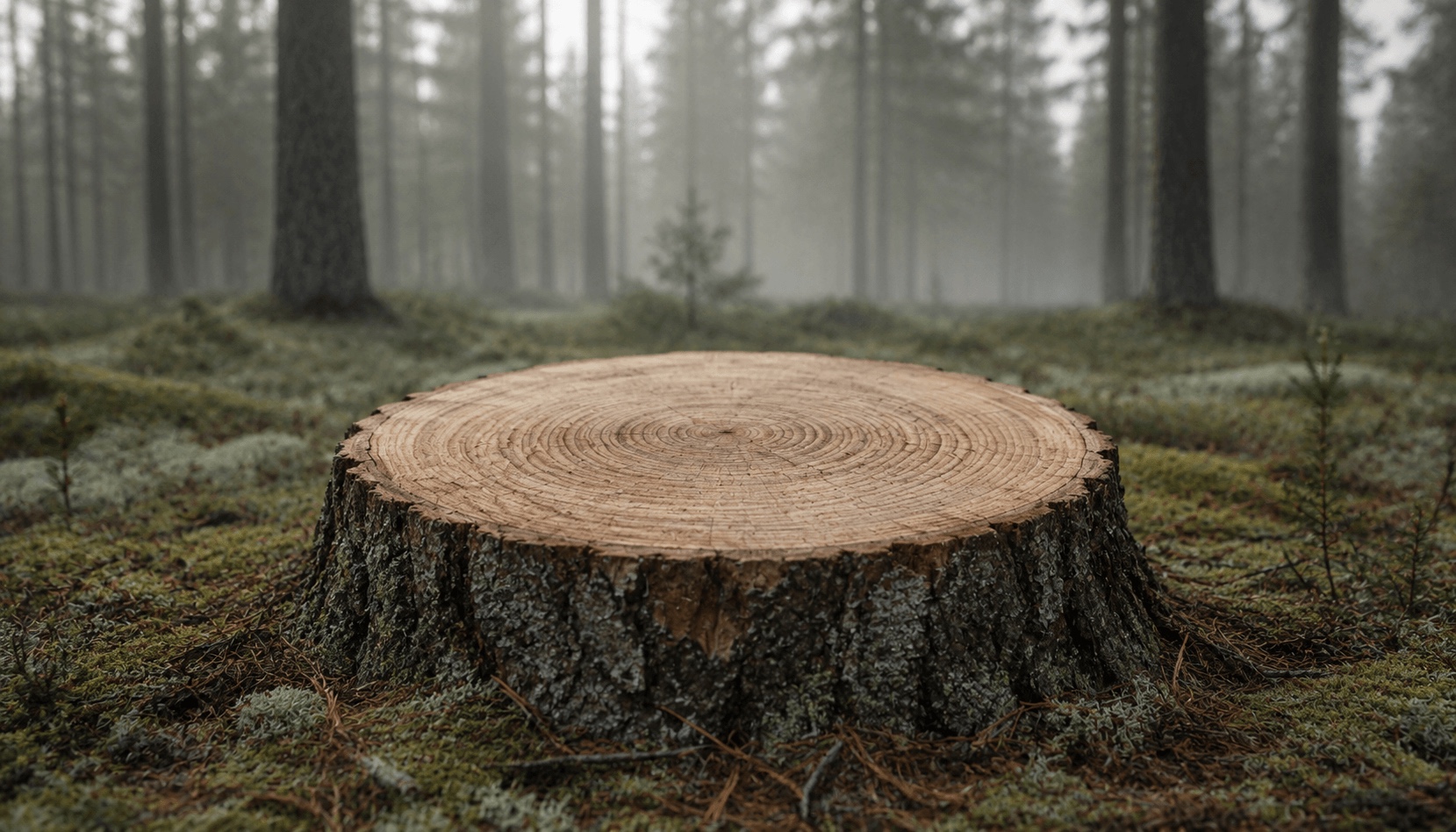
The Hidden Cost of Conventional Toilet Paper: 17 Trees Per Ton
Toilet paper is the rare product that is made from virgin trees, used for seconds, and can never be recycled afterwards. We dig into the FAO and NRDC data on what that actually costs the planet.
If you had to design the most wasteful possible consumer product, it would look a lot like a roll of conventional toilet paper. It is made from virgin trees — not recycled paper, not crop residue, but freshly logged softwoods. It is used for a few seconds. It is then flushed into a wastewater stream where it can never be recovered or recycled. And we go through it, globally, at a rate of roughly 42 million tonnes a year.
The category is so embedded in daily life that almost nobody asks where it comes from. The honest answer is uncomfortable.
The 17-trees-per-ton number — where it comes from
The figure most commonly cited in industry literature is that one ton of virgin-pulp toilet paper consumes around 17 mature trees and 70,000 to 90,000 litres of water, depending on the mill and species mix. The number traces back to pulp-and-paper industry yield data and has been used by organisations from the FAO to the NRDC in different forms.
It's not a precise universal constant — yields vary by tree species, by pulping process (kraft vs sulfite), and by mill efficiency. But as a rough order-of-magnitude estimate, 17 trees per ton is the figure that has held up across multiple independent analyses.
Stack that against global tissue demand and the arithmetic gets bleak fast:
- Global tissue paper production: roughly 42 million tonnes per year.
- Trees implied at 17 per ton: over 700 million trees per year, much of it virgin softwood.
- Water implied: enough to supply a city the size of Pune for years.
This is for a product category that no one would describe as "essential infrastructure" in the way that, say, packaging or construction lumber is.
Why toilet paper is uniquely wasteful
Many paper products are wasteful, but toilet paper sits in its own category because of a specific combination of properties:
- Single-use. Used once, never again.
- Instant disposal. Lifespan from package to drain is measured in seconds.
- Unrecyclable after use. Once it has been used and flushed, the fibre is contaminated and enters the wastewater stream. Unlike a cardboard box or an office printout, there is no second life.
- Often made from virgin fibre. Much of the premium tissue market still uses freshly logged softwood because the long fibres give the "soft and strong" texture consumers prefer.
Compare this to a corrugated cardboard box. The box is also paper-based, but it is typically made from recycled fibre, used for weeks or months, and then recycled again — often through five to seven cycles before the fibre is too short to reuse. A toilet roll gets one cycle. From tree to sewer in under a minute.
The boreal-forest problem
The NRDC and Greenpeace have published a series of reports — most prominently the Issue with Tissue series — examining where North American tissue brands actually source their pulp. A significant share traces back to the Canadian boreal forest, one of the largest intact forest ecosystems left on Earth and a critical carbon sink.
The boreal stores an estimated 30 to 40 percent of all terrestrial carbon on the planet, according to multiple ecological surveys. Logging it for tissue paper is a particularly inefficient use of a globally rare ecosystem. The trees take 80 to 200 years to mature in that climate. They are then pulped to make a product that is flushed within seconds.
The same general dynamic plays out — in smaller and warmer form — in eucalyptus and acacia plantations across Brazil, Indonesia, and parts of South Asia, where monoculture pulpwood replaces more biodiverse native forest.
The Indian household math
Let's bring this down to a number you can hold in your head.
A typical Indian urban household of four people, using toilet paper as a primary bathroom hygiene aid, consumes roughly:
- 4 rolls per person per month (industry-typical figure for households where toilet paper is the primary option; lower where the health faucet is also used).
- 192 rolls per year for a family of four.
- Roughly 48 kg of finished tissue per year, depending on roll weight.
At 17 trees per ton, that's somewhere in the order of 0.8 trees consumed per family per year in tree equivalents — and a proportional share of the water, energy, and chemical inputs. Multiplied across India's growing tissue-using population, the aggregate is large and growing fast.
This is not meant as a guilt trip. The point is that a routine, invisible purchase has a measurable upstream footprint, and the footprint compounds with every household that joins the modern tissue-using consumer class.
What bamboo changes
The bamboo alternative isn't magic, and we'll be honest about its limits in a dedicated bamboo vs wood post. But the core difference is straightforward:
- No trees cut. Bamboo is a grass. It regrows from the rootstock after harvest, like cutting your lawn.
- 3 to 5 year harvest cycle, against 20 to 200 years for softwoods.
- Roughly 30 percent less water per ton of pulp in industry assessments.
- No reforestation debt. Every harvest leaves the grove alive.
That doesn't make bamboo "free" in ecological terms — there is still energy used in pulping, freight to consider, and packaging to manage. But on the question of should this consumer category be made from virgin trees at all, the answer is increasingly no.
What you can actually do this month
If you want a single, concrete step that doesn't require a lifestyle overhaul:
- Switch the next roll, not every roll. Order one trial pack and use it like you'd use any other. No commitment, no zero-waste pledge.
- Match your household size. A family of four orders differently from a single person. We sized our pack options around real Indian household consumption.
- Set a refill cadence once. A subscription means you decide one time and never have to remember again — which is, frankly, the only way most household changes actually stick.
The 17-trees-per-ton number is the kind of statistic that's easy to read and easy to forget. But the choice it points to is the easiest one in your sustainability toolkit — and one of the few where the planet impact actually adds up.
Ready to buy?
Browse our full product catalogue or request wholesale pricing.