Is Bamboo Toilet Paper Septic-Safe? Yes — Here's the Science
The single most-asked question from HORECA buyers and Indian households. We explain septic-tank biology, what actually causes blockages, IPC-CIB disintegration standards, and where the 'bamboo is too tough' myth comes from.
If you've spent any time selling bamboo tissue to Indian hotels, restaurants, or property managers, you already know the question. It arrives within the first thirty seconds of every conversation, and it arrives in roughly the same form every time:
"Yes, yes, all that is fine — but will it block our septic tank?"
The short answer is no — quality bamboo toilet paper is septic-safe, and is engineered to disintegrate in water at the same rate as conventional virgin-pulp tissue. The longer answer involves a small amount of septic-tank biology, a slightly larger amount of misunderstanding about what actually clogs pipes, and a single test you can do in a glass of water at your own desk.
How a septic tank actually works
To understand what is and isn't septic-safe, it helps to know what the tank is doing.
A standard household septic tank is a two-stage anaerobic digester. Wastewater enters the first chamber, where:
- Solids settle to the bottom and form a sludge layer.
- Fats and oils rise to the top and form a scum layer.
- Liquid effluent sits in the middle and flows out to a soak pit or leach field.
Inside the sludge layer, anaerobic bacteria break down organic matter — including toilet paper — into simpler compounds and gases (mostly methane and CO2). Over time, the tank needs to be pumped out, typically every 2 to 5 years for an average household, because not everything fully digests.
For toilet paper, the relevant question is: how quickly does it disintegrate into small enough fragments that the bacteria can act on it, and that it doesn't accumulate as undigested mass?
What actually clogs pipes and tanks (it's not tissue)
This is where the popular wisdom is most wrong. The things that actually cause septic and sewer blockages in Indian homes, in rough order of frequency:
- "Flushable" wet wipes. The single biggest cause of modern plumbing blockages globally. Despite the marketing, almost all flushable wipes are made with non-woven polyester or PET fibres that do not break down in water. They wrap around pipe internals, accumulate, and form fatbergs.
- Sanitary pads, tampons, and diapers. Designed to absorb and hold liquid, not release it. Never disintegrate.
- Cooking oil and grease. Solidifies into scum and accelerates the tank's pump-out cycle.
- Hair. Forms mats that trap other debris.
- Cotton buds, dental floss, condoms, cigarette butts. All of these survive the journey to the tank intact.
- Thick, dry recycled tissue with high wet-strength additives. A small contributor in homes that use a lot of it. Recycled tissue with industrial wet-strength chemistry can take days to fully disintegrate.
Regular, well-made toilet tissue — bamboo or wood pulp — is not in the top causes of blockage. It is, by design, engineered to fall apart.
The disintegration test (the science part)
The standard industry test for tissue disintegration is variously known as the "slosh box" test or IPC-CIB-style soak test. The setup is simple:
- A single sheet of tissue is placed in a container of room-temperature water.
- The container is agitated at a fixed rate (mechanical shaker or stirrer).
- The time-to-disintegration is measured — typically, "disintegration" is defined as the tissue breaking into pieces small enough to pass through a standard sieve.
The published thresholds vary slightly between testing bodies, but the broad benchmarks are:
- Standard virgin softwood toilet tissue: Disintegrates in roughly 30 seconds to 2 minutes of light agitation.
- Quality bamboo toilet tissue: Disintegrates in roughly 45 seconds to 2 minutes, well within the same range.
- "Flushable" wipes (the cause of fatbergs): Disintegrate, if at all, over hours to days and often don't break down at all in the timescale a sewer flow gives them.
- Paper towels and kitchen rolls: Disintegrate in 5 to 30 minutes. These should never be flushed even though they are technically paper.
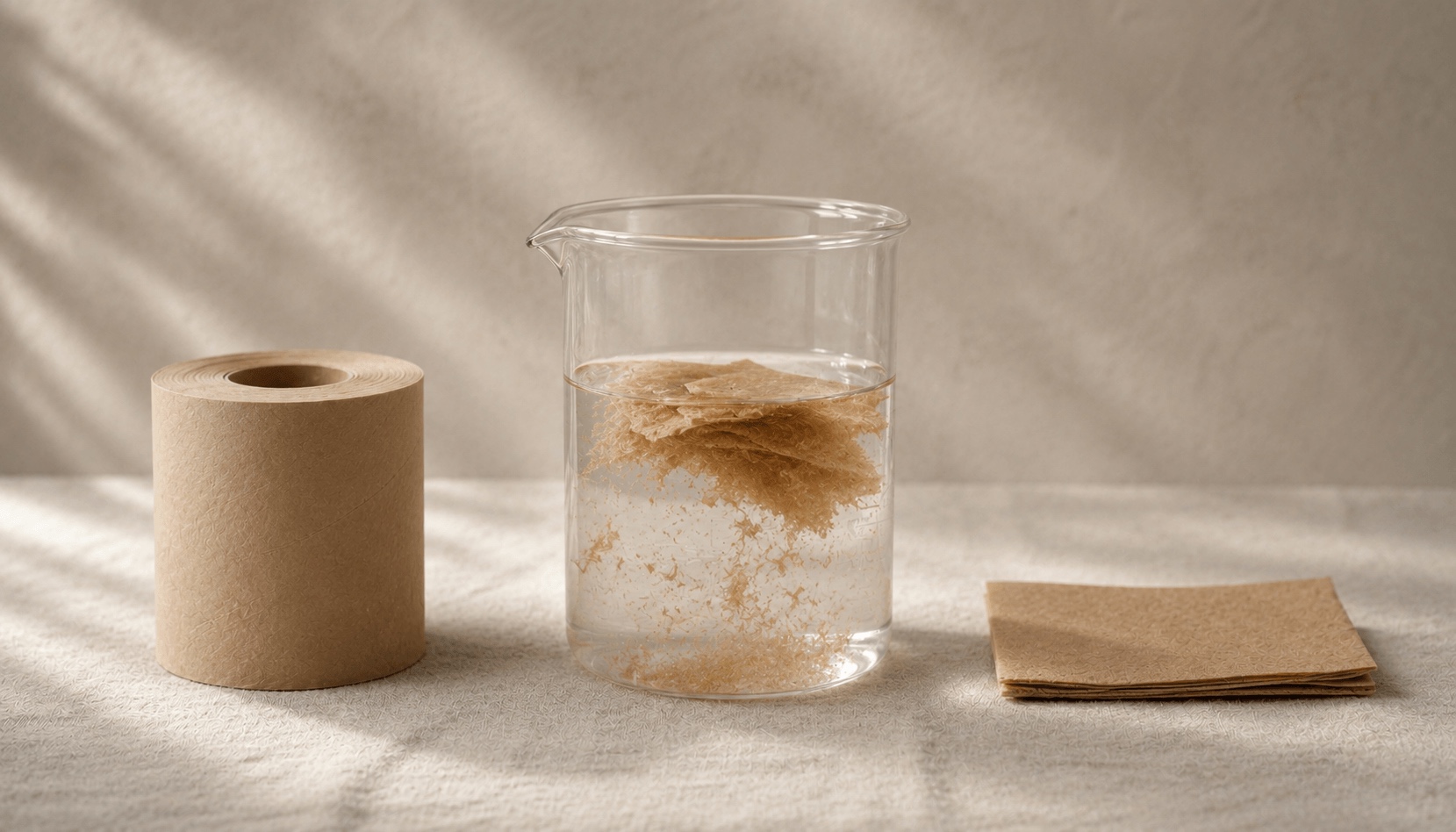
You can run a kitchen-scale version of this test yourself. Drop a single square of bamboo tissue into a glass of water, give it a gentle stir with a spoon, and watch it break apart in under a minute. Do the same with a piece of any "flushable" wipe, and you will be surprised how stubbornly intact it remains.
Why the "bamboo is too tough" myth exists
There is a real botanical fact lurking behind the misconception. A bamboo culm — the standing pole — is genuinely tougher than a comparable softwood log of the same dimensions. Bamboo is used as scaffolding in construction in much of Asia because of this strength.
The mistake is in assuming that toughness of the raw plant carries through to the finished tissue. It doesn't. Once a bamboo culm has been:
- Chipped into small pieces.
- Pulped chemically or mechanically to separate the fibres.
- Washed and bleached.
- Pressed into the thin, lightly bonded tissue web you see on a roll.
…the result is a material whose properties are governed by the fibre length and the bonding chemistry of the tissue, not by the raw culm. Bamboo's individual fibres are 1.5 to 3 mm long — actually shorter than the long fibres of northern softwood — and they bond in tissue with the same hydrogen-bonding mechanism as any other cellulose tissue.
In water, those hydrogen bonds break in seconds, and the tissue falls apart at the fibre boundaries. There is nothing about bamboo that resists this any more than wood pulp does.
What to verify before you buy (especially HORECA)
If you are a hotel, restaurant, or facilities manager and need to certify that the tissue you stock is septic-safe, here's the short checklist:
- Ask for the disintegration test data. A reputable supplier should have IPC-CIB-style or EDANA-style soak test results available. The numbers should sit in the 30-second to 2-minute range.
- Confirm no wet-strength resins. Wet-strength additives are sometimes used in industrial-grade napkins and paper towels but should never be in toilet tissue. They are the chemistry that makes "flushable" wipes problematic.
- Confirm no plastic film or wax coating. Quality bamboo tissue is bare paper. No coatings, no laminates.
- Check the ply construction. Standard 2-ply and 3-ply bamboo tissue disintegrates fine. Ultra-thick "industrial bulk" tissue, regardless of fibre source, can be slower.
For our own product, the test data and the manufacturing specs sit in the our bamboo story section of the site. Bulk inquiries from HORECA buyers come through the same channel as our regular products page.
The practical conclusion
Quality bamboo toilet paper is septic-safe. It is designed to disintegrate at the same rate as conventional tissue, has no plastic content, no wet-strength chemistry, and no coatings that would cause it to behave like a wipe.
If your septic tank has been working fine with conventional tissue, it will work exactly the same way with bamboo tissue. The thing that's putting your tank at risk — if anything is — is almost certainly the "flushable" wipes someone in the house has been quietly using, the cooking oil that goes down the kitchen drain, or the long pump-out interval. The tissue is, almost always, the innocent party.
If you'd like to start with a household-sized trial pack and run the glass-of-water test on your own kitchen counter, the 3-ply Classic is the most common starting point. And the subscription is how most of our septic-tank-skeptical first-time buyers end up staying.
Ready to buy?
Browse our full product catalogue or request wholesale pricing.