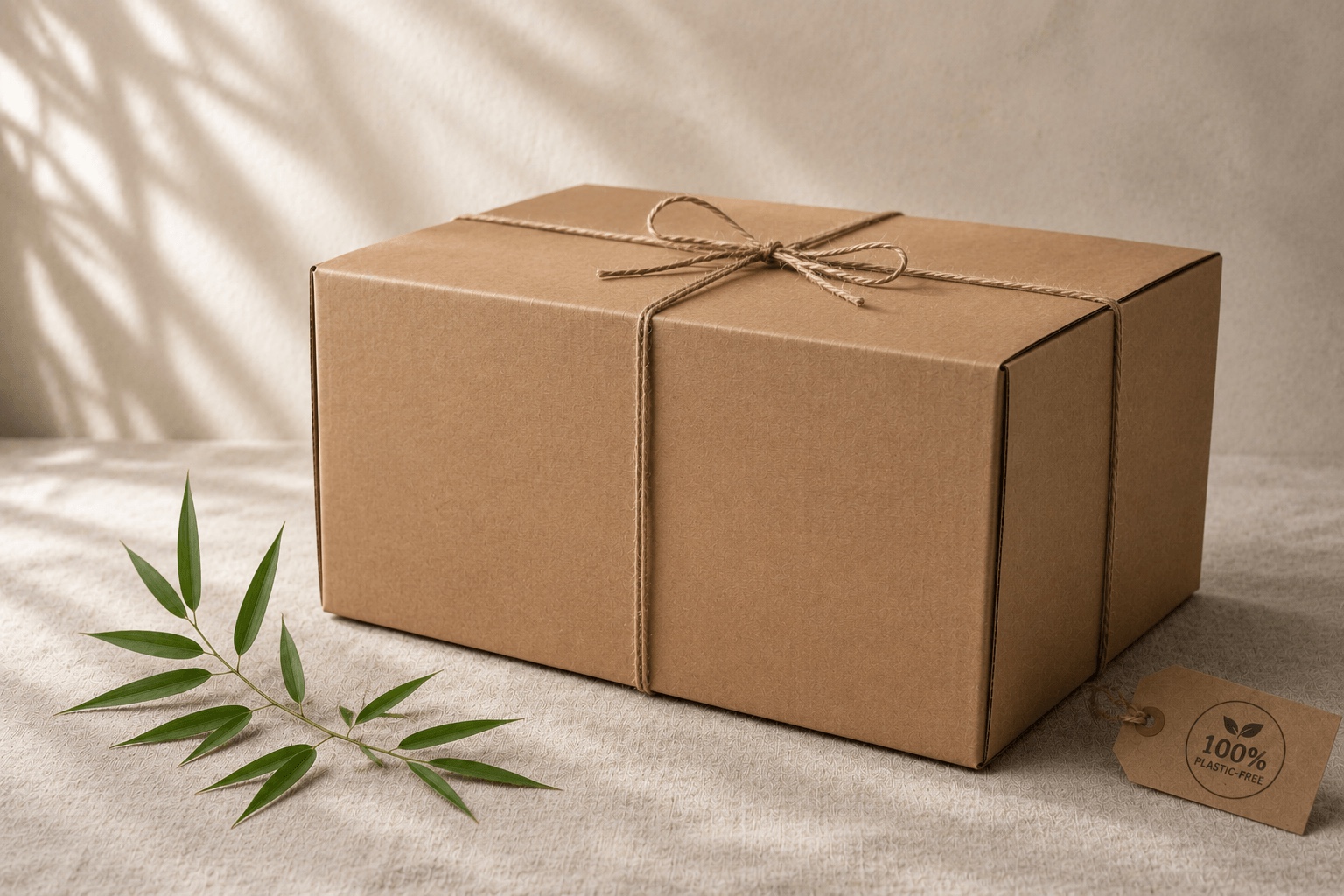
Plastic-Free Packaging in India: Why It Matters and Who's Doing It Right
India's per-capita plastic use is rising fast and bathroom products are a major hidden source. We break down the July 2022 SUP ban, what compliant packaging looks like, and what to check before you buy.
If you've ordered anything online in India in the last five years, you've probably noticed a small pile-up at the bottom of your kitchen bin. Bubble wrap. Polybag. Shrink film. Bubble wrap again, inside the bag, for no obvious reason. The product was eco-friendly — but the packaging was a single-use plastic museum.
Packaging is the part of the sustainability story that most brands quietly hope you won't audit. It's also the part that, post-July 2022, is no longer a voluntary nice-to-have under Indian law.
How much plastic India actually uses
India's per-capita plastic consumption is still lower than the global average — roughly 11 to 12 kg per person per year, against a global average of about 28 kg — but the trajectory is the part that matters. CPCB and industry estimates put national consumption growth at 8 to 10 percent per year, faster than most major economies.
A surprisingly large share of that plastic flows through everyday household categories that almost no one thinks of as "plastic products":
- Tissue and toilet paper packaging — shrink-wrap, polybag overwraps.
- Toothpaste tubes and toothbrush blister packs.
- Sanitary product wrappers.
- Shampoo and conditioner bottles.
- Kitchen towel multipack film.
- Cling-wrap for fresh produce in modern retail.
Bathroom and kitchen aisles — quiet, routine, low-attention aisles — are some of the biggest plastic-generating zones in the average Indian home.
The July 2022 Single-Use Plastic ban, in plain English
On 1 July 2022, the Ministry of Environment, Forest and Climate Change brought into force a ban on the manufacture, import, stocking, distribution, sale, and use of identified single-use plastic items. The list includes:
- Plastic carry bags below 75 microns (later raised to 120 microns in December 2022).
- Polystyrene and expanded polystyrene cutlery and decorations.
- Plastic straws, stirrers, plates, cups, and cutlery.
- Wrapping and packaging films around sweet boxes, invitation cards, and cigarette packets.
- PVC banners under 100 microns.
- Earbuds, ice-cream sticks, and balloon sticks with plastic stems.
The rule that matters most for tissue and personal-care brands is Rule 4 of the Plastic Waste Management (Amendment) Rules, 2021, which prohibits non-recyclable, low-utility plastic packaging on specified product categories — and the Extended Producer Responsibility (EPR) regime, which puts the cost of end-of-life management of plastic packaging back on the producer.
In practice, this means a tissue brand that uses a multilayer plastic shrink film around its packs is now responsible for collecting and recycling an equivalent weight of plastic elsewhere. Brands that use paper, glassine, or kraft packaging avoid that liability entirely.
What compliant, genuinely-better packaging looks like
There is a difference between "packaging that technically complies with the SUP ban" and "packaging that is actually doing right by the planet." The compliance bar is low; the better bar is the one to look for.
Here is the spectrum:
- Kraft cartons — uncoated brown paperboard. Recyclable, compostable, made from recycled fibre in most cases. The gold standard for outer packaging.
- Paper wrap with paper tape — a single sheet of paper folded around a product, sealed with paper-based gummed tape. Fully recyclable in the standard paper stream.
- Glassine bags — translucent, smooth, paper-based. Looks plastic-like but is actually paper. Good for moisture barrier without plastic.
- PLA / bio-plastic films — derived from corn or sugarcane. Technically compostable, but only under industrial conditions that don't exist in most Indian municipalities, so functionally these still go to landfill. Better than virgin plastic but not the win it's marketed as.
- Recycled PET (rPET) — better than virgin plastic, still plastic, still in scope of EPR.
- Multilayer plastic (MLP) shrink film — the worst case. Almost never recycled in practice. Banned or in scope of EPR under current rules.
A good packaging audit on any "eco" product takes about ten seconds: pick up the pack, read the symbols, find the words "kraft", "FSC-certified paper", "100% paper", or look for a plastic-resin code. If you see anything from #2 (HDPE) to #7 (other), it's plastic.
What to look for as a consumer
When you're buying any household product that markets itself as sustainable, the packaging audit is the fastest way to separate the real brands from the green-washed ones. Three quick checks:
- Outer carton. Is it kraft brown, uncoated, with a paper label? Good. Is it glossy printed with a plastic film over it? Less good.
- Inner wrap. Each unit inside the carton should be in paper, glassine, or unwrapped. A clear plastic sleeve around each roll is the most common giveaway of greenwashing.
- Tape and labels. Is the tape paper-based (you can tear it cleanly)? Are labels paper or vinyl? BOPP tape is still plastic.
If you'd like to see what this looks like in practice — outer carton, inner wrap, even the tape — we documented our packaging supply chain on the our bamboo story page.
What's hard about doing this in India
It's worth being honest about why most brands haven't switched yet. Plastic-free packaging in India faces real friction:
- Moisture in the monsoon supply chain. Paper packaging can absorb moisture during long-haul transit, especially through coastal hubs in June to September. Brands have to either use heavier paper or accept some seasonal damage.
- Cost. Kraft cartons run 15 to 30 percent more expensive per unit than polybags at small scale. At larger scale, the gap narrows.
- Logistics partners. Many third-party warehouses default to plastic packaging unless explicitly briefed otherwise. Eco brands have to actively manage their 3PLs to keep plastic out.
- Consumer perception. Some customers still associate "shrink-wrapped" with "hygienic" — which is misleading, since cartoned bamboo tissue is wrapped at the mill in a clean environment and never opens until you do.
The brands doing this well are doing it because they decided the maths works only if the packaging matches the product story — not because it's the cheapest option.
Why packaging is the integrity test
A bamboo tissue brand that ships in shrink-wrapped polybags is, charitably, missing the point. The product is the easy half of the story; packaging is where the brand's actual commitment shows up.
If you're shopping for a tissue brand, a personal-care brand, or any household product that calls itself sustainable — start with the carton, not the marketing copy. The carton doesn't lie. And if you're curious how we structure our own packs and refill cadences, our subscription page lays out exactly what arrives, in what carton, on what schedule.
Plastic-free packaging is the part of the sustainability story most consumers can audit in ten seconds. It's also the part most brands hope you won't.
Ready to buy?
Browse our full product catalogue or request wholesale pricing.