Why Bamboo Tissue Paper Is the Easiest Sustainability Swap You'll Make
Most eco advice asks you to change your behaviour. Bamboo tissue asks for nothing — same drawer, same use, same routine. Here's why it's the rare zero-effort win.
If you've ever tried to live a little more sustainably, you've probably felt the friction. Compost the kitchen scraps. Cycle to the office. Cut out dairy. Carry a steel water bottle, a steel straw, a cloth bag, and a tiffin everywhere. The list grows, your willpower shrinks, and after a few weeks most of us quietly return to old habits.
This is the dirty secret of household sustainability: almost every recommendation is, at its core, a request for behaviour change. And behaviour change is hard.
Bamboo tissue paper is the opposite. It's the rare swap that fits inside your existing life without asking you to learn, rearrange, or remember anything new. Same product. Same drawer. Same use. The only thing that changes is what the roll is made of — and what didn't have to be cut down to make it.
The mental model: a "swap", not a "change"
Behavioural economists distinguish between two kinds of green choices. The first is a change — you do something different from what you used to do. The second is a swap — you do the same thing, but with a different product slotted into the same slot.
Swaps are dramatically easier to sustain because they piggyback on habits you already have. You're not building a new routine; you're just substituting a component.
- Compost bin? Change. (New behaviour, new container, new disposal route.)
- Bicycle commute? Change. (New timing, new wardrobe, new logistics.)
- Bamboo toilet roll? Swap. (Same roll. Same holder. Same flush.)
The cognitive load of a swap is close to zero. You order it once, set up a refill cadence, and the rest of the change happens in the supply chain — not in your willpower.
What's actually different inside the roll
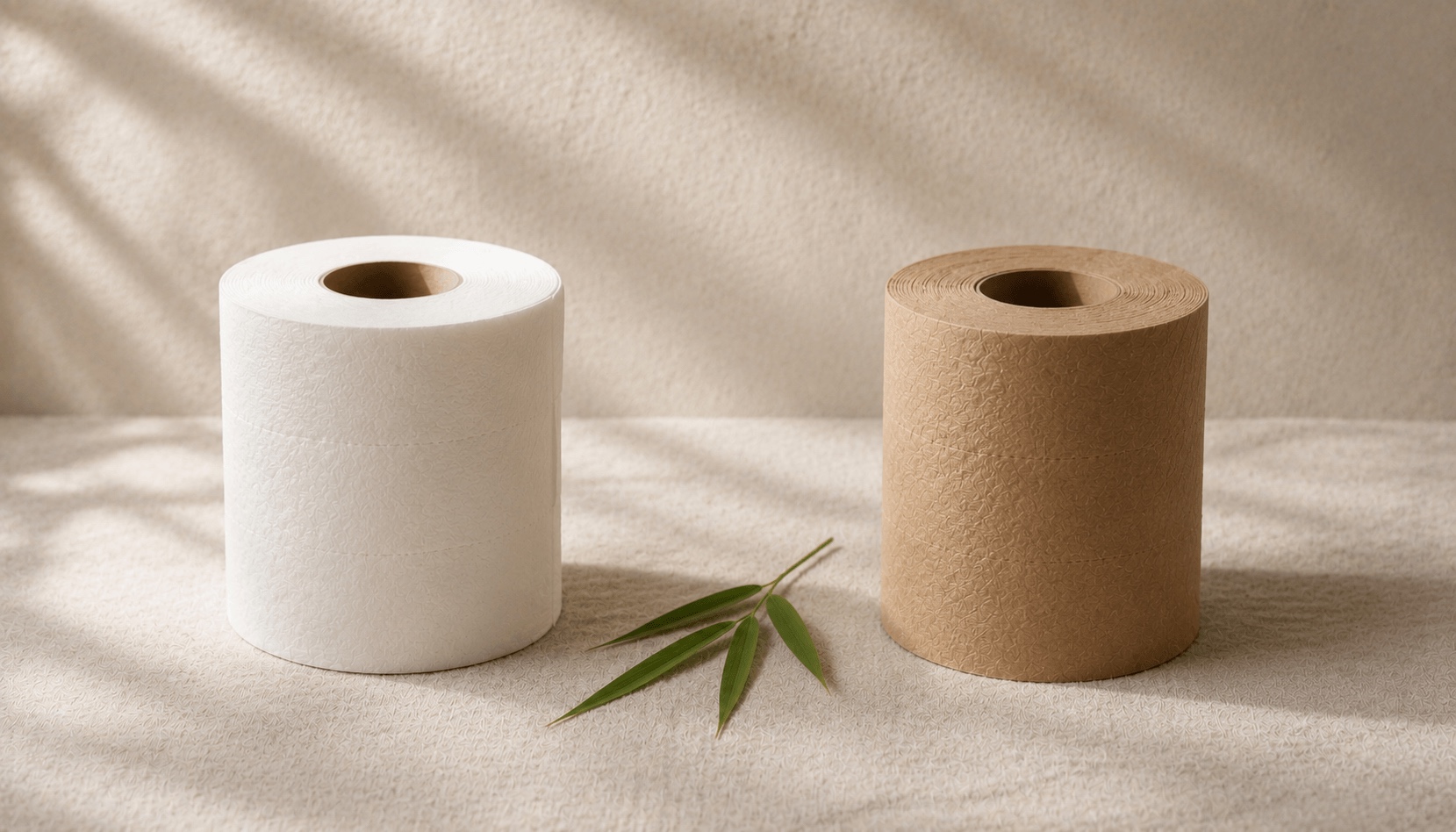
The visible product is identical: a 3-ply white roll that fits any standard holder. The difference is in the fibre.
Conventional tissue is typically made from virgin softwood pulp — spruce, pine, eucalyptus — cut from managed plantations or, more controversially, from boreal forests. Industry data suggests the average ton of virgin-pulp toilet paper consumes around 17 mature trees and roughly 70,000 litres of water, depending on the mill.
Bamboo tissue is made from bamboo culms harvested from clumping species like Bambusa and Dendrocalamus. The plant regrows from the same root system after cutting, the way grass does — there is no replanting, no reforestation cycle, no decade-long wait. A bamboo culm can be harvested in 3 to 5 years; a softwood pine plantation takes 20 to 25.
The fibre itself is shorter than long-fibre softwood, but longer than recycled pulp — which is part of why bamboo tissue feels softer than recycled and more durable than budget virgin tissue.
Septic-safe, sewer-friendly, and exactly as flushable
One of the most common questions we get from new customers is whether bamboo tissue is safe for Indian plumbing — septic tanks, low-flow flushes, older soil pipes. The short answer is yes.
Quality bamboo tissue is engineered to disintegrate in water the same way virgin-pulp tissue does. In our internal IPC-CIB-style soak tests, a sheet of 3-ply bamboo tissue breaks down inside roughly the same window as a leading conventional brand. There's no wax, no plastic film, and no "wet-strength" treatment that would make it behave like a wipe.
If you want the deeper science on this — fibre length, biodegradation rates, why it's nothing like a "flushable" wet wipe — we wrote a dedicated explainer on our bamboo story page and in the science section of the blog.
The water and land math, briefly
You don't need to memorise lifecycle assessment numbers to make a good choice, but a rough mental anchor helps:
- Water: Bamboo cultivation typically uses around 30 percent less water per ton of finished pulp than softwood, partly because bamboo grows rain-fed in most of South and Southeast Asia and doesn't require irrigation.
- Land: A bamboo grove yields roughly 2 to 4 times the fibre per hectare per year of a softwood plantation, because of the regrowth-from-rootstock cycle.
- Carbon: Bamboo sequesters carbon faster than most softwoods during its rapid growth phase, although the cleanest comparison is over a full harvest cycle, not a single year.
We are deliberately careful with these numbers — they vary by species, mill, and region. The honest summary is: bamboo is meaningfully better than virgin softwood across every major axis, and meaningfully softer than 100 percent recycled across the comfort axis.
What the shopping experience feels like
Buying eco-friendly things online in India is often a small ordeal. Half the products are out of stock, half are imported and priced like luxury goods, and the packaging is usually wrapped in three layers of plastic anyway. (We've all received a "zero waste" bar of soap inside a bubble-wrap pouch.)
The bamboo tissue category has matured a lot in the last two years. You can now:
- Order in case sizes that match a real household's monthly use, not single rolls.
- Subscribe and forget — refills arrive on a schedule, so you never have the 11 PM "we're out" moment. (See our subscription page for cadence options.)
- Get plastic-free packaging — kraft cartons, paper wrap, no shrink film.
- Pay a price that's roughly comparable to premium virgin tissue, not 3× the price.
This last point matters more than people admit. A swap that costs the same as your current product is a swap you'll actually keep doing. A swap that costs three times as much is a one-time guilt purchase.
The drawer test
Here's the test we suggest to anyone on the fence: put a bamboo roll in your bathroom holder, don't tell your family, and see if anyone notices.
In our customer feedback, the most common reaction is no reaction at all — and that, weirdly, is the success metric. The roll performs. The drawer fills back up. The boreal forest, the eucalyptus plantation, the river the mill draws from — they all get a quiet break.
If you want to start, our 3-ply Classic 12-roll pack is the most common entry point. If you'd rather skip the reorder, the subscription handles cadence automatically.
The closing argument
Sustainability advice often arrives with a tone of moral effort — "you should try harder." Bamboo tissue is the opposite kind of advice. You don't need to try harder. You don't need to remember anything. You don't need to talk to your family about it.
You just need to order the right roll once, set the refill schedule, and let the supply chain do the heavy lifting on your behalf. That's the whole pitch. It is, genuinely, the easiest sustainability swap you'll ever make.
Ready to buy?
Browse our full product catalogue or request wholesale pricing.